Who are the Scythians? Where did they come from? What makes them worthwhile to talk about?
The Scythians is a lesser known steppe civilization from the Pontic Steppe around the Black Sea. It is widely believed that the Scythians were of Iranian origin, as their language and religious beliefs show similarities to the cultures of that time period. However, recent evidence from 2017 has found that they genetically developed independently of these cultures and likely came from a more northern culture, the Yamna. The Scythians were a prominent culture from the 8th Century BC to the 3rd Century BC.
Much like the Mongols, the more famous of steppe warriors, they influenced history not by sustained conquest, but by raiding. Also like the Mongols, they were a culture, not a true civilization, as they were made up of a collection of tribes. The most prominent group were the Royal Scythians, the aristocracy of these tribes and acted as the dominant leaders in military campaigns. The Scythians briefly held control over the Medes in the Iranian Plateau, who were frequently fought with ancient Egypt. This control was short lived as a large number of Scythian warlords were trapped and killed in a feast by the leader of the Medes, Cyaxares, in 620 BC. After this, the Scythians aided the Achaemenid Empire, the first true Persian empire, in the destruction of the Assyrians as they defeated them at their capital Nineveh in 612BC.

Under Darius II rule of the Achaemenid Empire, he famously sought to take Greece. In doing so, despite the kingdoms being allies against the Assyrians, he needed to carve out territory around the Black Sea. He was able to easily take this territory and the Scythians were separated into three kingdoms after this.
The Scythians would not rise to prominence again until 496 BC under king Scyles. He was able to carve out territory into Thrace as well as recapture territory and settlements from the Greeks in the Caucus. While there was a slight fall, Scythian King Ateas was able to unite a large number of Scythian tribes in the early 4th Century BC. He gained further control in Thrace which allowed him to set up a successful trade route in from the Adriatic Sea to the Black Sea, the homeland of the Scythians. Unfortunately, a knew kingdom was gaining prominence, Macedon under Philip II, father of Alexander the Great. Philip was able to successfully push back the Scythians from Thrace and back to the Black Sea, where King Ateas died in battle. Further decline continued in the 3rd Century BC when Celts began to migrate into their territory in the Black Sea and Sarmations, of Ural origin, began to take their land as well. Pontus, a kingdom set up by Alexander the Great’s general, also defeated them numerous times in the 2nd century BC. These defeats seem to have destroyed the Scythian culture and way of life as it seems they transitioned to a more settled way of life and assimilated with other cultures. The Scythian’s were completely destroyed in the 3rd Century AD when Goths destroyed their capital.
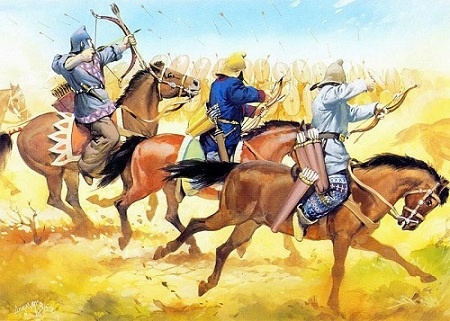
The Scythians, despite being nomadic, were highly militaristic. As mentioned, the Royal Scythian tribe was especially militaristic rather than just focusing on pastural life. The Scythians were also very skilled in metallurgy, likely learning it from the neighboring Middle Eastern civilizations. They did have an archaic form of Zoroastrianism religion despite not having a written language. They clearly did conduct trade amongst their neighbors and other tribes within the culture, likely in grain. The Scythians did have a unique art form and focused on animals, a style that has been known as the Scythian Animal Style. They were influenced by Persia and Greece and there they did have some scholars that frequented Athens during the Athenian Golden Age.
Herodotus, the Greek historian, is the most prominent source of Scythian information. Overall, their dominance of the Caucus for nearly 600 years is their legacy. They were uncontested militarily in the Middle East until Darius II strengthened and grew the Achaemenid Empire. Scythian control over the region of Thrace was uncontested until Philip II of Macedon. Their military helped develop Persian and Macedonian militaries as their mounted style of fighting had been unrivaled. The cultural developments in metallurgy and art shows a unique feature that they were not just pastural and militaristic, but had a defined social structure despite never being clearly unified.
 Daily Dose of History